A simple, phased approach to transitioning farm operations ownership to the next generation.
One of the hardest questions in farm succession planning is: How does the next generation actually become an owner?
Not someday when Mom & Dad die. Not after another 20 years of working for the farm and hoping everything works out. How do we start moving ownership during Mom & Dad’s lifetime?
Here’s one way we do it.
Like most good succession planning ideas, the concept itself isn’t terribly complicated. The details matter, of course, but the basic idea is pretty simple.
Step 1: Separate the land from the farming operation
Let’s say Mom & Dad own a successful farming operation worth about $2 million. That includes the grain, livestock, machinery, tools, equipment and other operating assets.
Basically everything except the farmland.
Mom & Dad have one daughter who farms with them. Her husband farms with them too. They’re good operators, they’ve proven themselves, and Mom & Dad want Daughter & Son-in-Law to eventually take over the farming operation.
So Mom & Dad create an LLC and transfer the operating assets into it. We’ll call it “Farm Operations, LLC.” Mom owns 50% and Dad owns 50%.
The farmland stays outside the Farm Operations, LLC.
That distinction is important because land and operations are two different succession planning issues. The land may have been in the family for generations. It may have substantial appreciation. There may be off-farm children who should eventually receive an interest in it. Mom & Dad may also need rental income from it during retirement.
All of those things affect how we plan for the land.
So for purposes of this example, we’re leaving the land alone. We’re talking about transitioning the “business” that farms the land.
Step 2: Start giving Daughter & Son-in-Law ownership
Once the operating assets are inside the LLC, Mom & Dad don’t have to figure out how to give Daughter a combine this year, 40 cows next year and half the grain inventory three years from now.
Instead, they can transfer ownership interests in the LLC.
In 2026, the federal annual gift tax exclusion is $19,000 per donor, per recipient. Because Mom and Dad are separate donors, and Daughter and Son-in-Law are separate recipients, we have four potential annual gifts:
- Dad → Daughter: $19,000
- Mom → Daughter: $19,000
- Dad → Son-in-Law: $19,000
- Mom → Son-in-Law: $19,000
That’s $76,000 of LLC ownership transferred in year one using the annual gift tax exclusion.
With no IRS filings required.
Then they do it again next year. And the year after that. And the year after that.
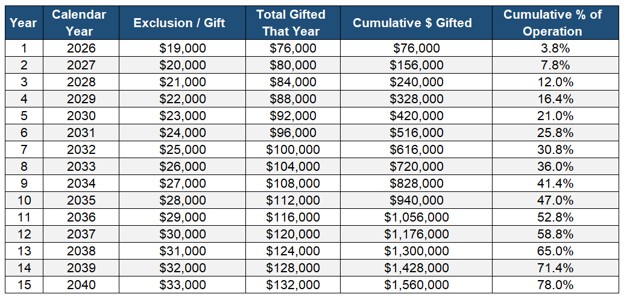
For illustration, let’s assume the annual exclusion increases by $1,000 every year. After 15 years, Mom & Dad will have transferred approximately $1.56 million of LLC ownership.
On our hypothetical $2 million operation, that’s 78%.
Daughter & Son-in-Law would cross 50% ownership around year 11. Mom & Dad started with 100% of the farming operation, and 15 years later Daughter & SIL own 78% while Mom & Dad own 22%.
We didn’t need one giant transaction to make it happen.
We simply started early enough to let time do some of the work.
How does the annual transfer actually happen?
You’re not writing Daughter a $19,000 check. You’re transferring enough LLC units or percentage ownership so that the value of the interest being transferred equals the intended gift.
For a very simplified example, assume Farm Operations, LLC is worth exactly $2 million and has 2,000 ownership units outstanding. Each unit would theoretically represent $1,000 of value, so a $19,000 gift would equal 19 units.
Real life is obviously more complicated. The LLC’s value can change from year to year, and the value of a minority LLC interest isn’t necessarily determined by simply dividing the company’s total value by the number of units. Depending upon the facts and governing documents, valuation discounts may also come into play.
But mechanically, the process isn’t particularly complicated.
Each year, we determine the value of the LLC interest being transferred. Mom & Dad then sign the appropriate documents transferring those LLC units to Daughter and Son-in-Law. Depending on how the LLC is structured, that may involve a simple assignment or bill of sale documenting the transfer.
Then we update the LLC records, including the member schedule or ownership ledger, to reflect everyone’s new ownership.
The following year, we do it again.
And we keep good records.
That’s an important part of this. If we’re going to treat the farm like a serious business, we need to document ownership like a serious business.
Why give them ownership now?
This is actually the part of the strategy I like most, and it has very little to do with gift taxes.
Daughter & Son-in-Law get skin in the game.
I’ve seen plenty of situations where a 45-year-old son or daughter is supposedly “taking over the farm,” except Mom & Dad still own everything.
Mom & Dad own the machinery, cows, grain, land, and bank accounts. The 45-year-old “successor” owns a pickup and a pair of work boots.
That’s not much of a succession plan.
There’s a big difference between saying, “I work on Dad’s farm,” and saying, “I own part of our farming operation.”
Ownership comes with benefits, but it also comes with responsibility. Daughter & Son-in-Law participate in the profits when the operation does well, and they participate in the losses when it doesn’t.
Suddenly, buying a $600,000 piece of equipment isn’t just Dad’s decision that they’re watching from the sidelines. Working capital matters to them. Debt matters to them. Profitability matters to them.
And importantly, the value they’re helping create belongs partly to them.
That’s real succession.
But what about the farmland?
A common comment would be, “But the real money is in the land.”
Absolutely. And that’s exactly why I separated it.
This strategy isn’t intended to solve the land succession question. That’s a separate conversation.
In many farm plans, we’ll put farmland into its own entity and lease it to the operating farmer. Mom & Dad might own the farmland through a separate land entity while Farm Operations, LLC cash rents it.
That allows us to separate three things farm families sometimes accidentally lump together: land ownership, business ownership and management.
They don’t have to transfer at the same time. And they don’t necessarily have to transfer to the same people.
Maybe Daughter & Son-in-Law should eventually own the farming operation because they’re the ones farming. That doesn’t automatically mean they should receive all of the farmland too.
Maybe Mom & Dad keep the land and collect cash rent during retirement. Maybe the land eventually passes to all of the children. Maybe the land stays in a family Legacy Land Trust for many generations. Maybe we want the on-farm child to have the ability to continue renting and farming it without forcing a sale.
There are a dozen variations.
That’s why I don’t like treating “the farm” as one giant asset when we’re doing succession planning. The land is one issue. The operating business is another.
Why gift it? Why not make the kids buy it?
You certainly can.
Gifting isn’t the only option. Mom & Dad could sell LLC interests to Daughter & Son-in-Law over time. They could combine gifting and selling. They could gift some ownership each year while requiring the next generation to purchase additional ownership.
Which approach makes sense depends on the family, the operation, Mom & Dad’s financial needs and what everyone is actually trying to accomplish.
If Mom & Dad need $1.5 million from the operation to fund their retirement, giving away $1.5 million probably isn’t a very good succession plan.
Succession planning shouldn’t make Mom & Dad poor just so we can say we successfully transferred the farm.
But if Mom & Dad are financially secure and their goal is transitioning the operating business to the next generation, annual gifting can be a useful tool.
What if Daughter & Son-in-Law get divorced?
If you’re going to start giving meaningful ownership in a family business to a son-in-law or daughter-in-law, you better think through what happens if that marriage ends before you start making gifts.
This is where the LLC operating agreement becomes extremely important.
The agreement should contain appropriate transfer restrictions and buy-sell provisions. What happens after a divorce? What if Daughter dies? What if Son-in-Law dies? What if one of them quits farming? Can an owner transfer an interest to an outsider? Can someone force the company to buy them out? If so, how is that interest valued and where does the money come from?
Those aren’t questions you want to answer for the first time during a divorce, death or family fight.
The time to decide what happens when people no longer get along is while everybody still does.
There are tax details we shouldn’t ignore.
The annual gift tax exclusion is a federal tax concept, so the basic strategy isn’t unique to South Dakota.
But don’t confuse “no gift tax due” with “there are no tax consequences to think about.”
Farm operations can have deferred grain, accelerated depreciation, debt, negative tax basis and other tax attributes that make the real-world transaction more complicated than my clean $2 million example.
The tax classification of the entity matters. Basis matters. Valuation matters. How income, deductions, gains and losses are allocated among the owners matters too.
The annual gift tax exclusion also has technical requirements. Among other things, the interest being transferred generally needs to qualify as a present-interest gift. Certain restrictions in an LLC operating agreement can complicate that analysis.
In other words, don’t screenshot this article and start transferring LLC units at the kitchen table tonight.
The concept is simple. The implementation needs to be done correctly, and this is one of those areas where your attorney and CPA should be working together.
One more assumption behind the $1.56 million example
I intentionally made the original example simple by assuming the operation remains worth exactly $2 million for all 15 years.
That’s obviously not how farming works.
Machinery gets bought and sold. Grain and cattle prices move. Debt changes. Working capital changes. Profits get retained. Assets appreciate and depreciate.
So the LLC needs to be appropriately valued as ownership is transferred over time.
But there’s also an important benefit to moving ownership earlier.
Once Daughter & Son-in-Law own part of the company, they own part of the future growth too. If they own 30% of the company and the operation grows in value, some of that increased value is already theirs.
It isn’t all accumulating on Mom & Dad’s balance sheet waiting for the family to figure out someday.
Start sooner than you think you need to
Farm succession gets difficult when we wait until Dad is 78 and suddenly decide we need the 52-year-old son or daughter to own and manage everything by next spring.
A phased transition gives everybody some runway. Ownership can change gradually. Management can change gradually. Mom & Dad can see how the next generation handles increased responsibility, while Daughter & Son-in-Law have the opportunity to build equity and learn what it means to actually own the business.
And if circumstances change along the way, the family still has time to adjust the plan.
That’s really the bigger point of this entire example.
Farm succession doesn’t have to be one giant transaction.
We can separate the land from the operating business. We can decide who should own each. We can gradually transfer ownership and management while Mom & Dad are still around to help the next generation learn how to be owners.
A little bit every year for 15 years may not sound terribly exciting.
But successful farm succession usually isn’t about finding one clever trick.
It’s about starting early enough that you have options.
-Clint

- Farm Transition… $19,000 at a Time - September 24, 2026
- No Plan, No Legacy — Let’s change that. - September 21, 2026
- Fair Isn’t Equal – 12 Examples - September 3, 2026
